I did not start this master's because of a career plan. I started it after a diving accident in the Philippines and a conversation with a doctor who asked me the right question at the right time. This portfolio is what came out of the year that followed: honest about where I started, clear about where I am headed.
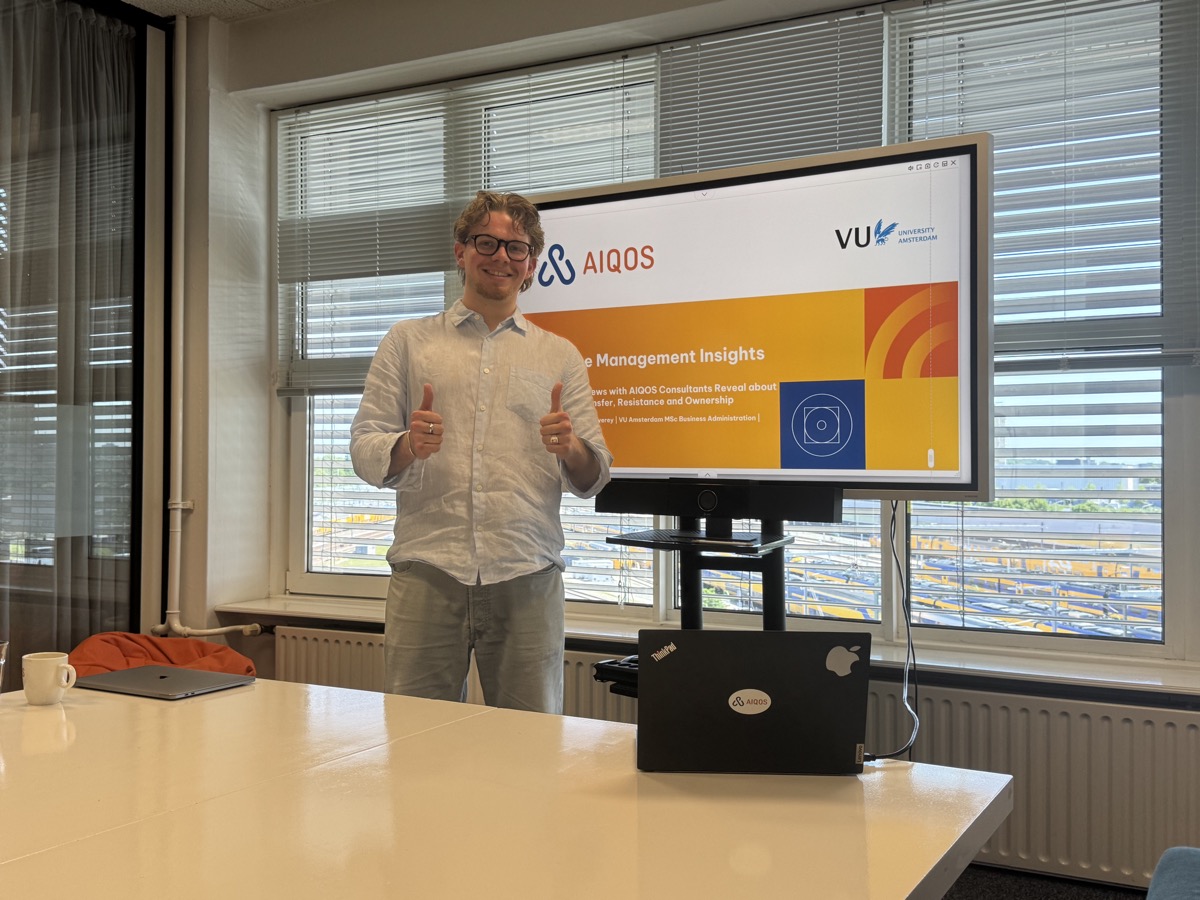
Presenting the AIQOS Change Story research at the AIQOS office, Den Haag
The most useful thing I can tell a future employer about myself is not my grade list. It is that I function as a connector, someone who bridges groups that would not otherwise talk to each other. In Burt's (1992) terms, I occupy structural holes. This showed up in my personal life before it ever showed up at work: I have always been the person who bridges different circles of friends, people who share no obvious common ground, and finds genuine connection on both sides. Professionally, it means I find common ground with people across seniority, sector, and background, and turn that into working relationships that actually hold.
Inside: a self-reflection tracing how the year disrupted what I thought I knew about myself; six pieces of evidence ranging from a research project at a change consultancy to a summer in a pizza kitchen; a skills rubric that maps the evidence honestly to the assessment criteria; a career page built around the environments where I do my best work; and the learning plan I wrote in September 2025, which makes the growth in everything else visible.
"If you love life, do not waste time, for time is what life is made up of."Bruce Lee
Each card links to the evidence behind it. Percentages are self-assessed, honest, not aspirational.
From translating 12 interviews into a practitioner framework at AIQOS, to hosting hundreds of professionals at a national congress. Audience-first, argument second.
From the North Sea to Manila, genuine engagement with perspectives well outside my own field, discipline, and comfort zone.
Including a rejection pattern I would rather not have noticed, two job applications I didn't get, and what I have done with both.
Building tacit knowledge unconsciously, and then watching someone else not have it, and understanding what that meant.
Finding common ground with people I had no obvious reason to talk to: and building professional relationships from it.
Identifying what is missing and building it from scratch: in a recruitment start-up, in a kitchen, and in a change consultancy.
Each piece shows something real about how I think, adapt, and develop as a professional.
All roads lead to Rome. Start anywhere.
Where it started, what the programme disrupted, where I genuinely struggled, and the professional I am becoming. ~1,200 words, 5 sections.
Six experiences, from a research presentation to a pizza kitchen, each with a reflection question I haven't finished answering.
How the evidence maps to the four assessment criteria, with self-assessed competency scores and honest notes on where each still falls short.
The roles I am aiming for, the environments where I do my best work, and the gaps I still need to close before I get there.
The goals I set in September 2024, the baseline that makes the growth in the rest of this portfolio visible.