Where it started
It did not begin with a career plan. In 2024, after a diving trip in Coron Bay, Palawan, I ended up in a hyperbaric chamber in Manila. The doctor who treated me, Dr. Jojo, asked me what I was doing with my life. When I told him, he was direct: do the master's. Not because of prestige, not because of salary prospects, but because others will see you as knowledgeable within your field. It helped him to have the confidence to eventually start his own medical facility that now specialises in treating divers.
That conversation, combined with a nagging question I did not want to carry for the rest of my life, what if I had done it, is what brought me back to the Vrije Universiteit van Amsterdam. I want to be honest about that starting point: I did not arrive with a clear professional identity or a defined vision of who I wanted to become. What I had was curiosity, and a low tolerance for regret.
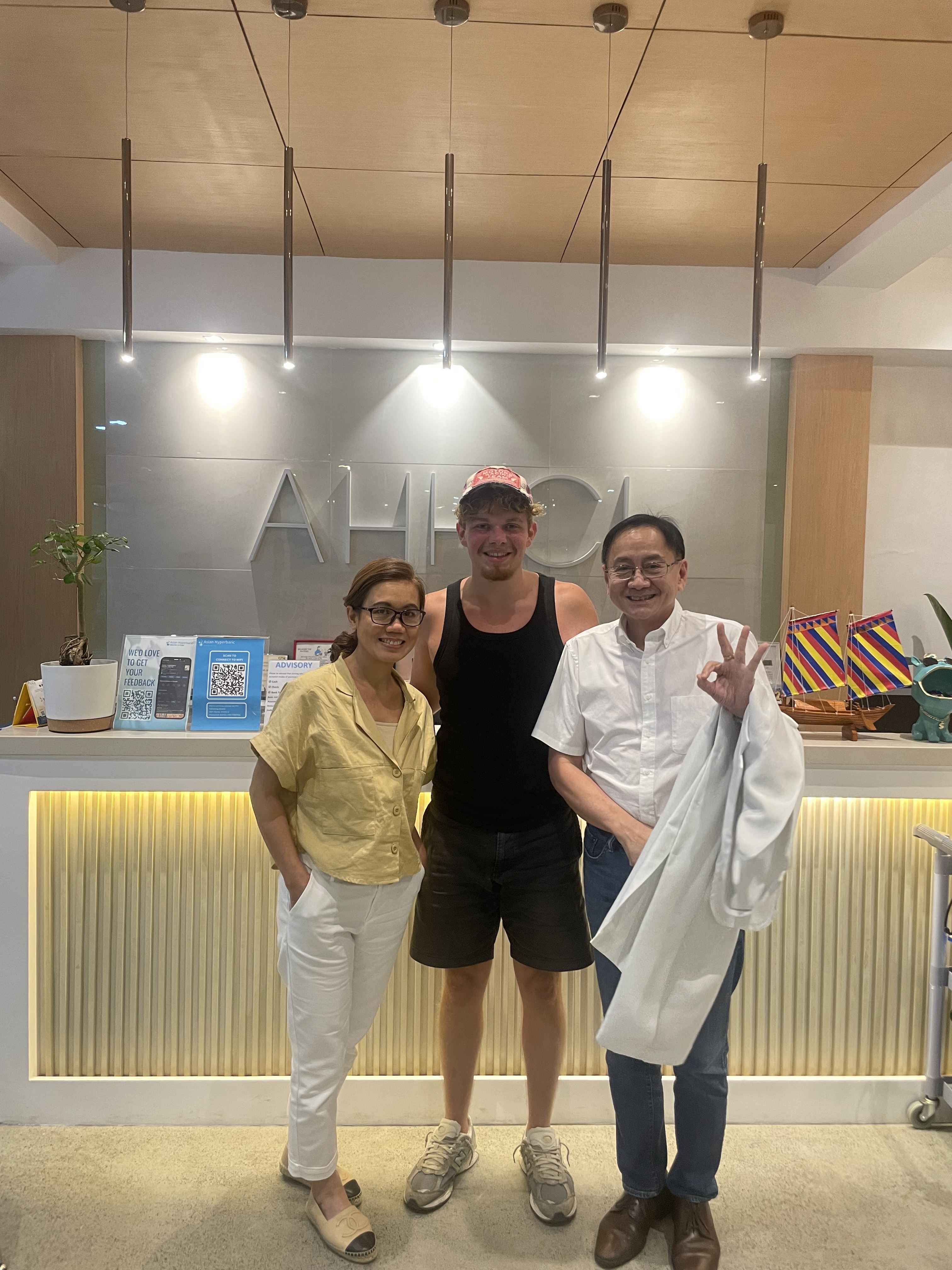
Dr. Jojo, Manila. The conversation that started everything.
Asian Hyperbaric
"Give credit where credit is due."
"Wie niet kan delen, kan niet vermenigvuldigen."
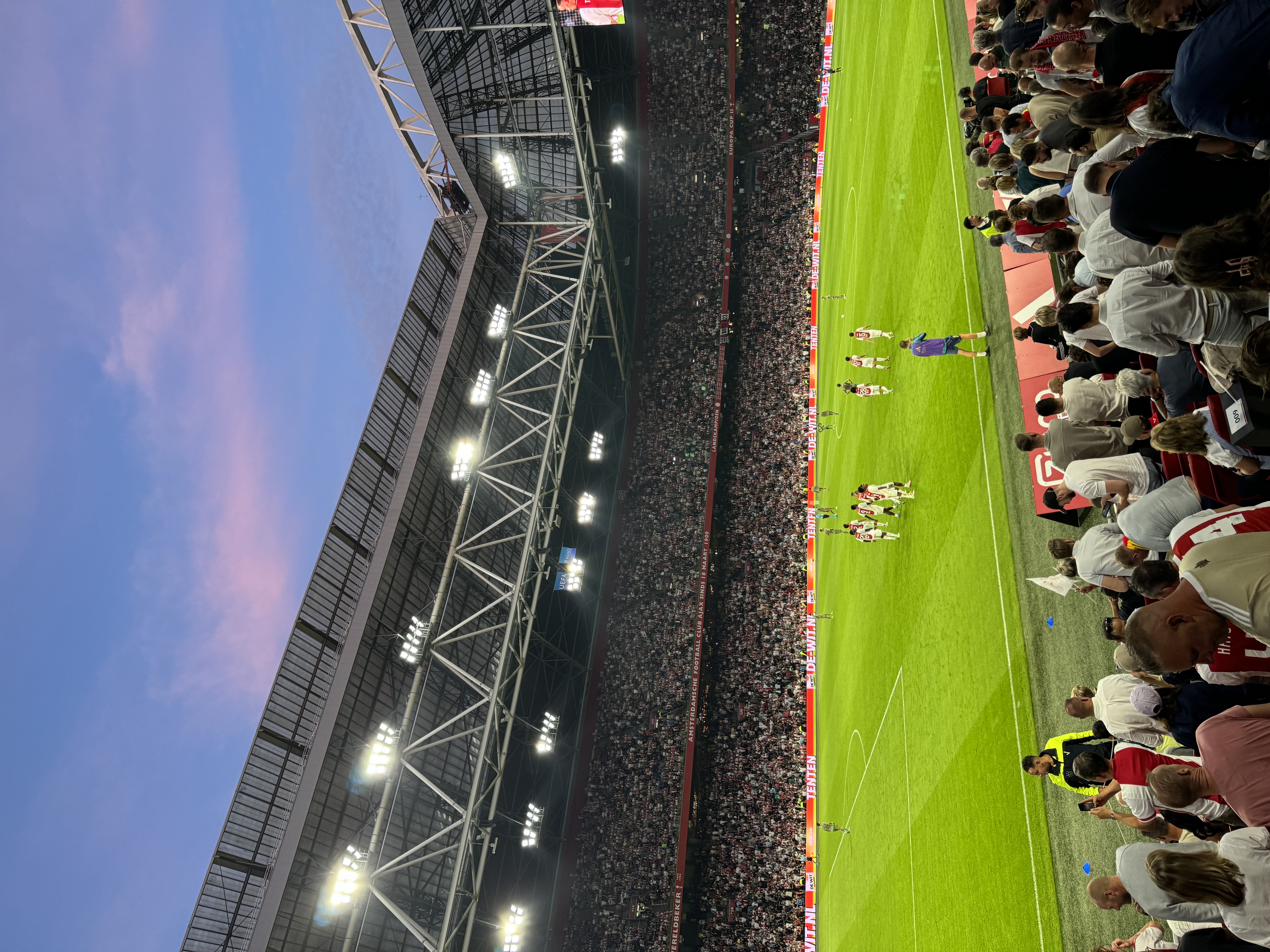
Johan Cruijff ArenA, Amsterdam. The same eleven players, a different manager.
"A good leader inspires people to have confidence in the leader; a great leader inspires people to have confidence in themselves."
Eleanor Roosevelt"Voetbal is simpel, maar simpel voetballen is het moeilijkste wat er is."
Johan CruyffWhat I expected, and what I found instead
When I started, leadership did not interest me much. I thought it was something you either had or you did not. That shifted early. In the first period, we explored how different types of change require fundamentally different leadership approaches: changing a company's culture demands something entirely different from redesigning a daily process. What made it click for me was thinking about football. The same squad of players, under a different manager, can produce completely different results. That is not luck. That is leadership. Once I saw it that way, I could not unsee it.
What the programme gave me, unexpectedly, was a shift in how I see people. I used to interpret difference as something to be cautious about. I now recognise that as a limitation in my thinking, not a strength. I will not name any peer students, but there is one I would have considered to be unusual, and previously I would have never spoken to her. While actually this person made me laugh perhaps the most times during the master's and was always challenging what I was saying to better how I articulate myself and my thoughts. Beyond that, I now have very high respect for her, because she truly carries herself the way she is, rather than pretending to be someone more likeable.
This connects to something I have known about myself for a long time but only recently had language for: I function as a broker. In Burt's (1992) terms, I occupy structural holes. This showed up in my personal life before it ever showed up at work: I have always been the person who bridges different circles of friends, people who share no obvious common ground, and finds genuine connection on both sides. Professionally, it means I find common ground with people across seniority, sector, and background, and turn that into working relationships that actually hold. The master's did not create this in me, but it gave me a framework to understand it and deploy it deliberately.
Where I genuinely struggled
The most destabilising moment of this year had nothing to do with a course grade. It was the growing question of whether any of this, the degree, the field, the career path, would still be relevant in ten years. The worst of it hit when Anthropic announced a model that could autonomously find security vulnerabilities at a scale no human could match. If AI could do that, what was left? Friends of mine who studied information science were the first to calm me down: they were becoming more productive with AI, not replaced by it. I also noticed that the people loudest about AI eliminating white-collar work entirely were often the ones profiting from that fear. That helped me hold it more loosely. Gary's Economics put it well: if AI increases your output from 100 to 150 burgers an hour, your employer is now capturing that extra value without paying you for it. A competitor notices you are underpriced and offers you 130 before your current employer does. In a competitive labour market, some of that productivity gain flows back to the worker.
What brought me back was not reassurance from a textbook. It was a conversation with Shirine Moerkerken, a change management professional who organised the Veranderen voor de Toekomst congress. Shirine works at the intersection of people and complex change. The congress itself was evidence of that: instead of a full day of speakers, she built breakout rooms with workshops led by practitioners, a deliberately human format. What she said stuck with me: there is a long way to go before we take instructions from AI rather than give them. Real change still has to be worked through with people.
What I concluded is that change management is fundamentally people work, not because technology cannot analyse or plan, but because legitimacy cannot be calculated. It has to be earned, in person, over time. At AIQOS I saw this up close. One of my colleagues was implementing a new financial system to replace an Excel file that had been in use for over ten years. Six hours of daily work: two to open it, two to make changes, two to save and close. By every rational measure, replacing it was obviously the right call. But the manager of that team was also the person who had built that Excel. Asking him to leave it behind was not a technical conversation. It was a personal one. No algorithm reads that. You need someone in the room who understands that resistance is not a problem to be solved. It is information about what the organisation has not yet addressed. Van den Ende and Van Marrewijk showed exactly this in the Amsterdam North-South metro line: the project did not recover when the engineering improved. It recovered when project actors stopped hiding behind technical expertise and started treating the community as stakeholders worth listening to. AI can map resistance. It cannot dissolve it.
On a more practical level, I struggled with saying no in my recruiting work. When a candidate had genuine motivation but did not meet the requirements, I found it difficult to reject them. Once someone opened up to me about why they wanted a role, they were no longer a stranger, and I do not like letting people who know me down. That is not a bad quality. But in a professional context it can blur the line between care and clarity, and clarity is what a candidate actually needs.
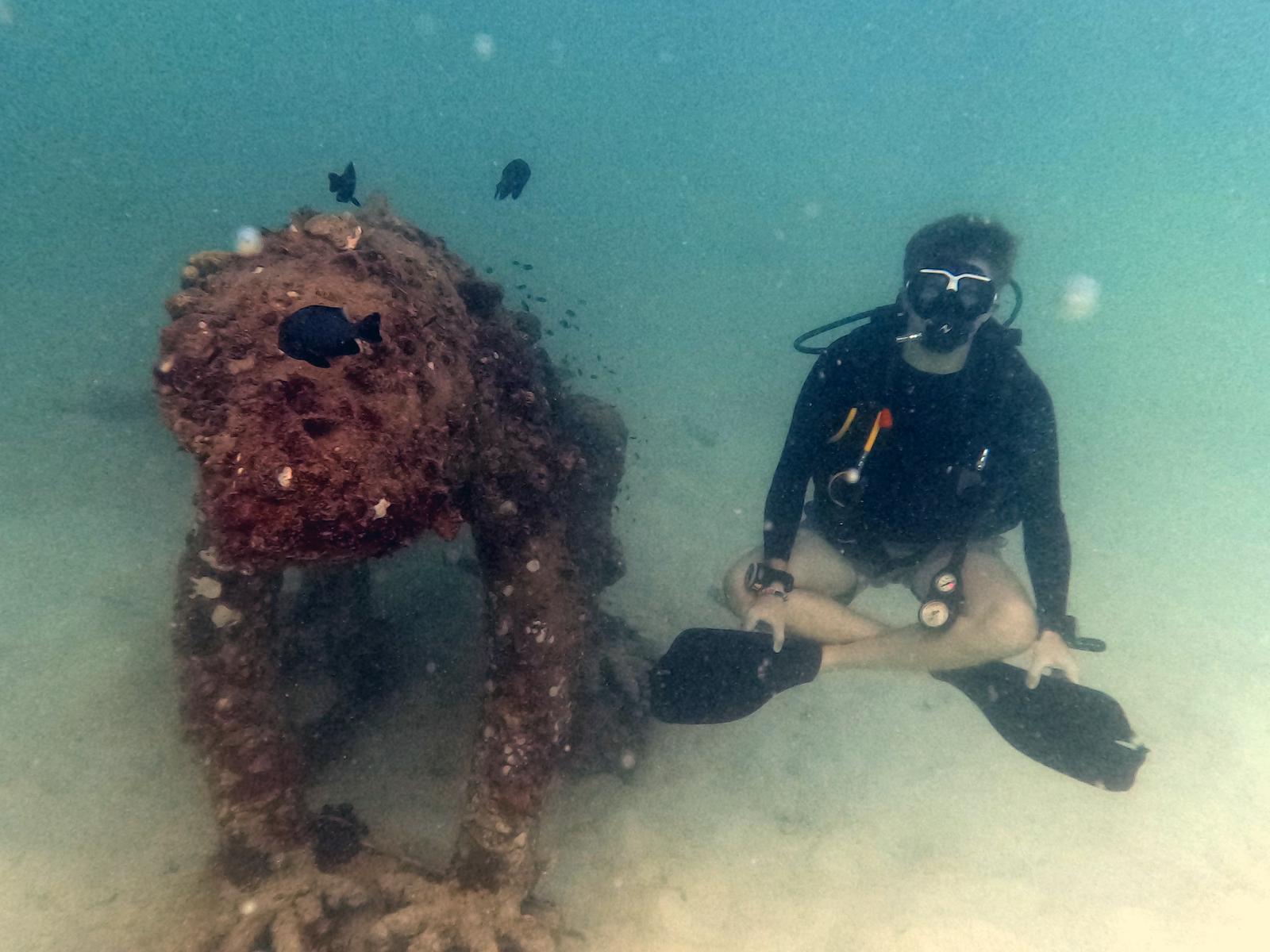
Koh Tao, Thailand. Where diving started.
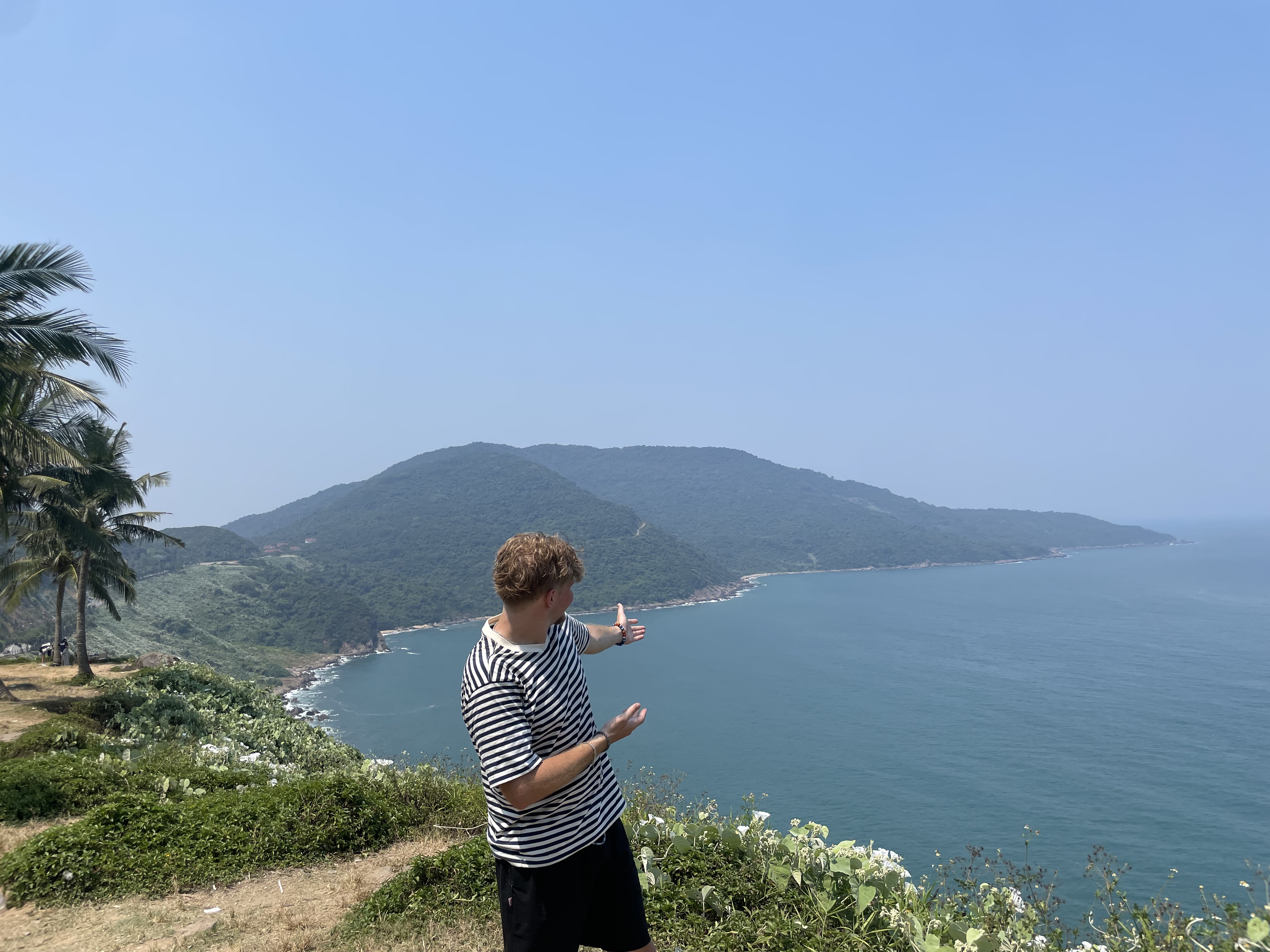
Vietnam. Looking out, not yet sure where.
Setbacks I'm still processing
This year I was rejected for two roles I applied for. The feedback was direct: in one case, I was too enthusiastic and did not read the room. In the other, I was questioned on my capacity for self-reflection.
The first I have accepted. I know this about myself. I lead with energy and I do not always calibrate it to the context. I started journaling after interviews, writing down what happened and what it told me about myself. What I learned from AIQOS is that confidence in a room comes from confidence in your process. They walk into client meetings certain of how they work, and that certainty creates trust. I want to build the same thing in myself, because you cannot bring energy that lands well if the energy is not grounded in something real.
The second rejection I am still sitting with. Looking back, it still does not sit fully right with me. I answered every question. What I did not do was go deep unprompted, and that is what she was looking for. But I have since learned that depth in reflection does not come from an opening question. It comes from probing. Good follow-up questions are what get you below the surface of someone's first answer. If you want the bottom of the iceberg, you have to ask for it. She did not. So when she said she was doubting my reflective capacity, my honest reaction was: bring it on. Whether that instinct was right or wrong, I notice that my first response to being questioned is to defend rather than absorb. That is worth knowing about myself.
What I do know is that writing this portfolio is part of working through it, and that a portfolio that only shows what I am proud of would prove the feedback right.
"A man who views the world the same at 50 as he did at 20 has wasted 30 years of his life."
Muhammad AliThe professional I'm becoming
I am more autonomous than I was a year ago. I take ownership more readily, and I have learned to ask for help earlier, which sounds simple, but was not natural for me.
My strongest asset remains connection. Put me in a room with people who have nothing in common, and I will find what they share. Not because I adjust who I am, but because I am actually interested in who they are. My internship at AIQOS sharpened this: working across clients and industries simultaneously, I learned that the ability to build trust quickly is not just a social skill, it is a professional one.
What I want from a work environment is autonomy with direction. Not someone standing over my shoulder, but also not a vacuum where nothing is clear. I want colleagues who give me energy, a manager who trusts me to deliver and tells me when I am wrong, and work where my output is actually visible. I have learned that I do not develop well when I have to earn the right to matter. I do well when I am given real responsibility early and treated like someone who can handle it.
The master's did not tell me who I am. It gave me better tools to figure that out.